Want to Play a Game Raise This Baby
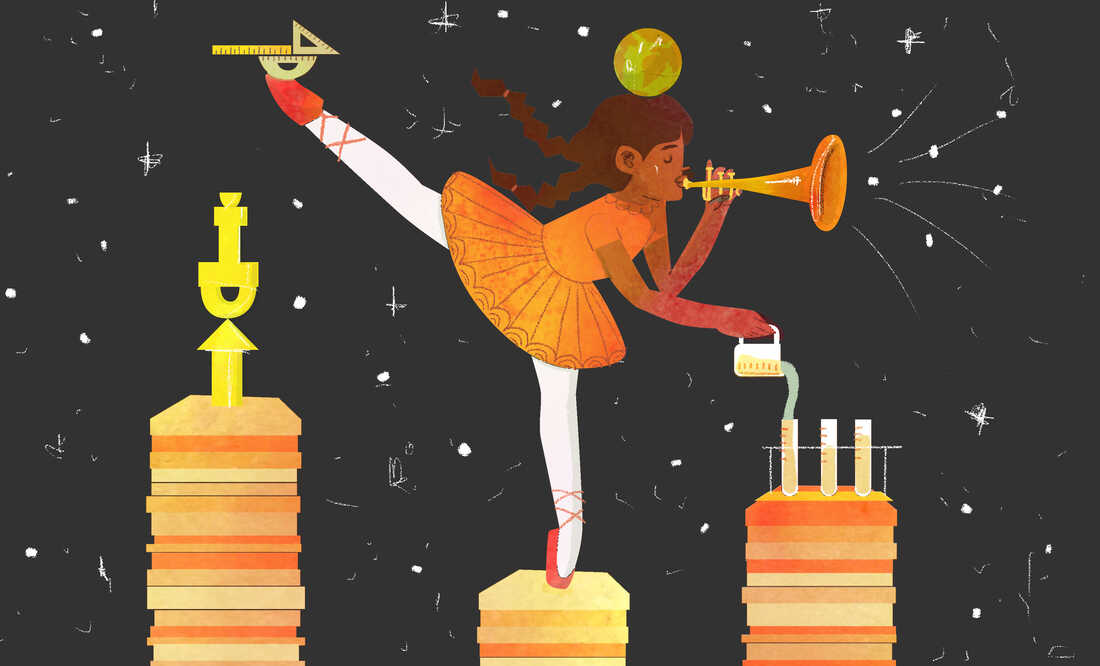
Nosotros all want our kids to attain their full potential, but that doesn't mean running math drills. Author Kathy Hirsh-Pasek explains the "six C's" that kids need to succeed and why raising brilliant kids starts with redefining brilliant. LA Johnson /NPR hibernate explanation
toggle caption
LA Johnson /NPR
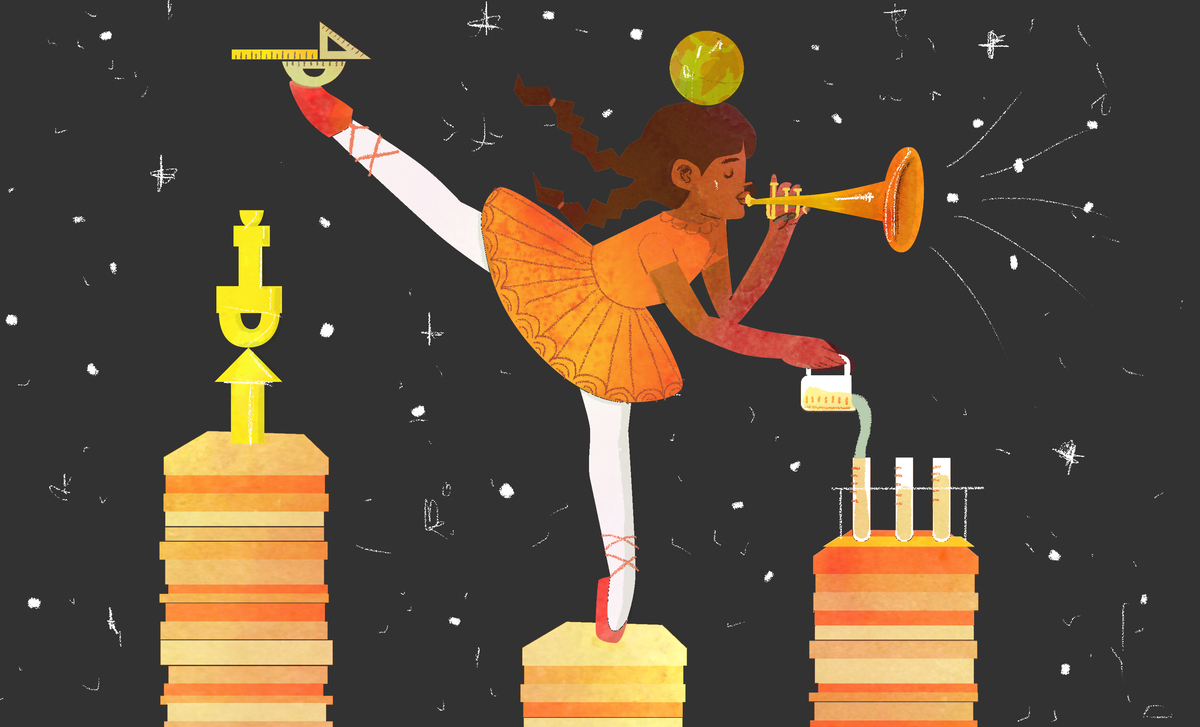
We all want our kids to reach their full potential, but that doesn't hateful running math drills. Author Kathy Hirsh-Pasek explains the "six C'due south" that kids need to succeed and why raising brilliant kids starts with redefining brilliant.
LA Johnson /NPR
Nosotros all want to heighten smart, successful kids, so it'due south tempting to play Mozart for our babies and run math drills for kindergartners. Later all, nosotros need to give them a head start while they're nevertheless little sponges, correct?
"It doesn't quite work that manner," says Kathy Hirsh-Pasek, a professor of psychology at Temple University and co-writer of Becoming Brilliant: What Scientific discipline Tells The states Well-nigh Raising Successful Children with Roberta Golinkoff. She'southward been studying childhood development for about 40 years.
So how does it work? NPR Education reporters and Life Kit hosts Anya Kamenetz and Cory Turner talk with Hirsh-Pasek most the "six C's" that kids need to succeed — collaboration, communication, content, critical thinking, creative innovation and confidence — and why raising vivid kids starts with redefining brilliant.
This interview was edited for length and clarity.
Cory Turner: This is your aureate opportunity to speak straight to all of these overzealous, anxious parents. And full disclosure, I have been i of them at times. Every parent is. And then explain to us why we need to cool our jets.
Kathy Hirsh-Pasek: Absurd your jets because it's healthier for your kid. Allow's look at what counts every bit success. Requite me your take on these 2 definitions:
Ane is your kid's success is to be a expert reader, a proficient writer and really good at math. Nosotros'll call that the traditional view.
Two is what I call the 21st century view of success: a happy, healthy, caring, kid who grows up to exist a collaborative person, a artistic innovator, a thinking person and a social person, while besides being a good denizen.
Turner: Oh, I'll accept door No. two.
Hirsh-Pasek: OK, the question so becomes how do you go in that location?
Pushing down the kind of math, reading and writing skills to younger and younger ages own't gonna give you No. ii considering you're not building a full, whole kid human being being.
The science says that the human brain was actually built to suffer wonderful, long-term relationships. I of my friends says it's a "socially gated brain."
Anya Kamenetz: Socially gated, what does that mean?
Hirsh-Pasek: Everything goes through the social. Everything we learn starts with collaboration and relationships. When you recall of it, we aren't born ready to hop out of the womb and into the earth. We have a lot of learning to do, and the learning is social.
Turner: You talk a lot virtually your six C's. The fundamentals [of] what every kid needs to thrive. The first of the 6, the virtually fundamental, is collaboration.
Hirsh-Pasek: 'Tis indeed.
Turner: Why?
Hirsh-Pasek : Well, if it's really the case that nosotros have this socially gated brain, and if nosotros learn everything through relationships, or at least everything starts through relationships, I think collaboration is the almost foundational piece of petty humans trying to go bigger humans.
The side by side office that'southward congenital on collaboration is communication — that's grunts, first words, mitt gestures and it's language. "How do I learn the contents of your mind? If I tin tap into your listen, Mom I'm going to know so much more than I can practice having to acquire it all on my own."
Kamenetz: Does that mean we should monologue at our children constantly and never stop talking? [Laughter.]
Hirsh-Pasek: Monologue is not quite the way to do it. It has to be dialogue, that back and along conversation. Equally parents, we sometimes jump in considering the baby didn't say something fast enough, and we don't want whatsoever lull in that conversation. But if we let it lull for only a moment even ten-week-olds tin can start to have a conversation with usa.
Now, once yous have a good communication base of operations congenital on a strong collaboration base, and then you tin can have strong content skills. And that can be reading content, writing content. There'south also learning-to-learn skills nether content, and that's things like learning how to focus your attention.
The fourth C, critical thinking, has to happen on top of content.
The fifth C, creative innovation, too depends on having strong content and strong critical thinking. Because you take to hit the correct buttons to know how to brand something that's truly novel. It doesn't just come from monkeys and a jar of paint. It comes from actually being thoughtful.
And our last C is confidence. This is a very hard one for me as a parent, and I suspect for everyone equally a parent, which is our children learn the most through failure. If we never let them fail, so they never know what it feels similar to thrive and succeed. So it'due south a growth mindset. It's dust. The perseverance to keep at it fifty-fifty though the tower fell downwards when y'all tried to make it loftier.
And so there are our six C'south, each one built upon the other and they wheel and bicycle like a spiral staircase.
Kamenetz: I want more examples of the six C's. One area that I know you've done some work on is at the grocery store. Then what does it expect like at the grocery store?
Hirsh-Pasek: When we're at the grocery shop or the corner shop, we're oft pretty rushed. We just want to become what'due south on the listing and exit. Equally part of what nosotros call our Playful Learning Landscapes experiments, nosotros tried to change that dynamic simply a piffling bit. And then nosotros put upward these crazy signs that say "I'k a cow. Milk comes from a cow. What else comes from a cow?" Nosotros were curious, would having these silly signs make any difference to the way parents engaged in the grocery shop? What were we looking for? Collaboration and communication. By gosh if we didn't get a 33% increase in the conversations when y'all put the signs upwardly. It's interesting that yous can change behavior by irresolute the environment around us.
Turner: I want to become back to the intersection of collaboration, communication and content. It seems to me in a classroom context that [kids] are more than likely to learn to choice up the content and become amend critical thinkers if they're doing that in a actually collaborative context. How important is it to smush the desks together and become kids working together?
Kamenetz : And is that actually the answer?
Hirsh-Pasek: I don't know that just smushing volition work. It'south a piffling more like creating a common goal and so trying to solve that goal together. And when yous practise that it's just so much richer.
It is amazing what our kids can do. I was taking my granddaughter Ellie — who was three at the time — we were just marching over to the playground and there happened to exist a little woods area along the way. So I pointed out that this really cool matter happened whenever there was a break in the trees, but I didn't tell her that part. I said "Oh my gosh, what is that?" She goes, "I don't know." I said, "I think it's your shadow. That's and then absurd." And she tried to chase her shadow for a little scrap. Then we went under a tree again, and of course the shadow disappeared. And and so we came out from under the tree, and at that place it was again. So together we were doing a science experiment. And I said, "I wonder if I could predict when you're going to see your shadow." So we did. We tried to get to a hypothesis of when nosotros might see that shadow, and past gosh if she didn't derive it.
Kamenetz: I want to know if you could illustrate for the states a little bit almost how the six C's work around things like getting our kids to help out around the house or motivation in school.
Hirsh-Pasek: There are fun games you can play that build on the six C's and get the motivation up.
Information technology turns out that you learn better when things are joyful than when they're not joyful. So I bet your kids would help you a whole lot more than if you made a game from the darks and the whites in that laundry room. Possibly you merely have to throw it from dissimilar lines: a three-point line, two-point line, maybe even accept the 3-quarter-point line and the one-quarter-bespeak line, and so they do fractions, right?
Play is active, not passive. And it turns out the way we learn is active, not passive. When we're sitting at that place like a couch white potato we aren't learning as much as when we're doing.
It should be meaningful as opposed to meaningless, so when we're memorizing flashcards stuff, that'south not play.
By and large, play is socially interactive every bit opposed to solo.
And it'southward iterative. That means each time you revisit information technology, there'south something new to discover about information technology. I think yous tin have true play where the child is the director, not the adult. And adults out at that place, don't interfere past jumping in and deciding what's going on with your child's play. Assist past setting the environment and going with their story and supporting it.
Source: https://www.npr.org/2019/10/10/769052767/the-key-to-raising-brilliant-kids-play-a-game
Belum ada Komentar untuk "Want to Play a Game Raise This Baby"
Posting Komentar