How should interpret the six stone water jars at Cana in John2?

The Dominicus lectionary gospel in Twelvemonth C for Epiphany 3 is John 2.one–11, the 'sign' of Jesus turning h2o into wine at the wedding in Cana. (In the Church building of England version of the lectionary, information technology was likewise the reading on Epiphany 3 in Yr B, though the ecumenical lectionary had a reading for Mark last yr; if anyone tin explain this, do comment below.)
Information technology offers us a good case of John's remarkable power in story-telling, where he combines an intense attention to realistic detail with powerful evocation of the scene. In 11 brusque verses, nosotros are taken into both the reality and the emotion of the event, so it is no wonder that the story is so well known that the phrase 'turning h2o into vino' (like 'walking on water') has go something of a cultural trope.
We have become used to reading John'southward gospel on two levels, the literal and the symbolic, and so it is not surprising that we should be warning to annihilation that might suggest symbolic significance in this story. Already John the Baptist has proclaimed Jesus as the symbolic 'lamb of God' (so we are non surprised when nosotros later on read that Jesus dies in John's chronology at the time of the sacrifice of the Passover lambs), and the first disciples inquire Jesus 'Where are you staying?' (John 1.38) using the word later translated 'constant', which becomes a symbolic term for the incorporation of the faithful disciple in the presence of God through Jesus in John xv.four. The Cana episode is introduced with one of John's characteristic temporal markers: 'on the tertiary day…' (John ii.1). Mark Stibbe and C 1000 Barrett disagree on whether this implies the wedding ceremony takes place on the sixth or 7th day of the narrative and so far, as indicated by the cumulation of temporal markers:
| Twenty-four hour period 1 | John 1.xix | John's testimony to the Jewish leaders | |
| 24-hour interval 2 | John ane.29 | 'the next mean solar day' | John's declaration of Jesus as lamb of God |
| Mean solar day 3 | John 1.35 | 'the side by side twenty-four hours' | The disciples seek Jesus |
| Day four | John 1.43 | 'the next day' | Jesus leaves for Galilee |
| Twenty-four hours 5 | The Sabbath? | ||
| Mean solar day half-dozen | John 2.1 | 'on the third 24-hour interval' | The first day of the week? |
(If 'the third mean solar day' implies an interval of two days between this and the previous event, and so we are on to Twenty-four hour period Seven in this 'calendar week' of Jesus' ministry building. Jo-Ann Bryant, Paideia p 55 and other recent commentators concur with Stibbe, that this is indeed Day Seven.) But Stibbe and Barrett practice agree on the significance of the phrase 'on the third 24-hour interval', anticipating the mean solar day of resurrection, the first mean solar day of the week and the commencement day of the new creation brought about by Jesus' dying and rising again. Stibbe takes this further, and sees the wedding itself every bit presaging the eschatological hymeneals banquet of God with his people (compare Rev nineteen.7–9). We notice this double significant repeatedly as the gospel unfolds: Nicodemus, dimly grasping Jesus' teaching, meets him in the twilight in affiliate 3, the usual time for a meeting in a hot climate, whilst the adult female by the well sees the light of the world past the light of the noonday lord's day in affiliate iv, an unusual time demonstrating she is outcast; in John nine.7 the man built-in blind in chapter 9 is sent to the Pool of Siloam (which means 'sent', of grade!); and when Judas goes out to beguile Jesus 'it was night!' (John 13.30) which it was both literally and metaphorically.
And so information technology is not surprising that many readers translate thesix stone water jars symbolically. Barrett comments:
It is possible although past no means certain that the number half-dozen is symbolic. Six, being less by one and seven, the number of abyss and perfection, would bespeak that the Jewish dispensation, typified by its ceremonial water, was partial and imperfect. (p 191)
Augustine goes much further, connecting the six jars with the half dozen ages of the earth up to the time of Jesus:
But observe what Himself says, The things which were written in the law, and in the prophets, and in the Psalms apropos me. And nosotros know that the police force extends from the time of which we accept record, that is, from the starting time of the world: In the beginning God made the heaven and the earth. Genesis ane:1 Thence down to the time in which we are now living are 6 ages, this beingness the sixth, as you have oftentimes heard and know. The kickoff historic period is reckoned from Adam to Noah; the second, from Noah to Abraham; and, as Matthew the evangelist duly follows and distinguishes, the tertiary, from Abraham to David; the fourth, from David to the carrying abroad into Babylon; the fifth, from the carrying away into Babylon to John the Baptist; Matthew ane:17 the sixth, from John the Baptist to the end of the world. Moreover, God made man afterward His own epitome on the sixth mean solar day, because in this sixth age is manifested the renewing of our mind through the gospel, after the prototype of Him who created us; Colossians iii:10 and the water is turned into wine, that we may taste of Christ, now manifested in the law and the prophets. Hence there were there six h2o-pots, which He bade exist filled with water. Now the six water-pots signify the six ages, which were not without prophecy. And those six periods, divided and separated every bit it were by joints, would be as empty vessels unless they were filled past Christ. Why did I say, the periods which would run fruitlessly on, unless the Lord Jesus were preached in them? Prophecies are fulfilled, the water-pots are full; but that the water may be turned into wine, Christ must be understood in that whole prophecy. (Tractates on John 9.half-dozen)
And in popular preaching, this symbolic number is hard to resist. The Jewish system of the law is all about ritual; information technology separates people into the clean and the unclean, so dehumanises them; and Jesus comes to practice away with the lot.
There are multiple issues with this kind of reading. Theologically, nosotros need to reflect on the origin of 'the law'. In the OT, it is clearly seen equally a souvenir from God—and so in this reading we must believe that Jesus is doing abroad with a nasty, dehumanising organization which originated with God himself. Canonically, there is a difficulty posed by Jesus' insistence that he 'has not come to do away with the constabulary, but to fulfil information technology' (Matt 5.17), and by Matthew and Paul's insistence (strongly implied by all the other gospels) that Jesus' life and ministry 'fulfilled' or was 'co-ordinate to' the Scriptures (ane Cor 15.3–4)—a belief that marks out canonical from non-canonical texts. Within John's gospel, despite the language of 'the Jews' (John ii.vi), we find a very Jewish message which insists on the primacy of Jewish agreement ('salvation is from the Jews' John 4.22) and which centres around the Jewish pilgrim feasts. And in this narrative, absolutely zippo any is made of the number six—most notably, Jesus changes the water into wine within the half dozen jars, and does not add a seventh. If we are to have the six as symbolising the apparent 'incompleteness' of Jewish belief prior to Jesus, then Jesus' completion of it involves using what is already there—and not adding anything to it! Reading advisedly, we also find that the climax of the story isnot the dissimilarity between water and wine—only that thebest vino has been kept until last. Just equally John i.16 (now rightly translated in modern versions) talks of Jesus bringing grace (the grace of the gospel) in place of (Gk: anti) grace (the grace of the law)—andnot grace in identify of legalism—then this miracle compares Jesus with the police force equally the best wine following good wine.
In his fascinating paper given at a recent Tyndale New Testament Study Group, Richard Bauckham brought two other factors into play in reading this story historically. The first relates to the rock h2o jars themselves, most which much has been written in scholarship in recent years. In that location are several things to note.
First, the importance of rock vessels is that they are not subject to the impurity laws in Lev 11.32–35 which demand that clay vessels which get unclean must exist smashed. So though they are much more expensive to make in the showtime place, in the long term they are more economic because they tin can be used repeatedly, even if they come up into contact with things which are ceremonially unclean. And so their presence indicates either that we are in a priestly household, or at least a household concerned with purity.
2nd, these very big vessels are very difficult to brand, since they must be carved from a single piece of rock. A quarry and workshop producing rock vessels was recently discovered not far from Cana in lower Galilee. But the engineering to produce big vessels needed the kind of lathes that were used past the Romans in making stone columns—so these big stone vessels bespeak quite a specific time catamenia of the Roman occupation of Judea and Samaria. Thus John's mention of them is pointing to a item and limited historical flow.
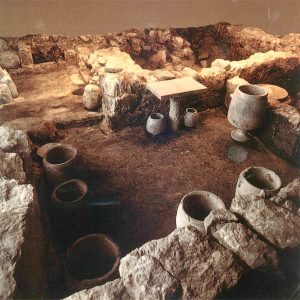 Thirdly, because these items were expensive, information technology was thought that they might be ostentatious luxuries which were put on display—and in fact you can run into from the examples in the motion-picture show to a higher place that they were finely fabricated, with a consequent and sophisticated design effectually the rims, for example. But archaeological evidence, peculiarly from the Burnt Firm in Jerusalem (a first century abode destroyed in the Roman siege of 70 Advertizing) shows that the large rock jars (qalal in Hebrew) were in theworking areas of the house. In other words, they had a practical importance, rather than beingness for display.
Only Richard added another dimension to this discussion. In ane Chron 24.vii–18 are listed the 24 'priestly courses' or divisions (Hebrewmishmar) which set out the pattern of duties of the priests through the year, with each 'grade' doing duty for two weeks each. Although in that location is some uncertainty in scholarship as to whether this was a historical reality in the time of the starting time temple, or an idealised reconstruction by the writer of Chronicles after the destruction of the temple and the exile, the design became important in the 2d Temple catamenia—and in fact allows united states to determine the judge date when Jesus was born. But why would such a schedule be so important if all the priests lived in Jerusalem? In fact they didn't, and and so this schedule allowed them to know when to travel to the city to complete their duty. A number of inscriptions take been found in synagogues from the period (and subsequently) which list these divisions, include the names of the towns related to each partition, and include an additional column of names, which Richard argues are the particular families within the divisions who lived in the various towns listed, and and then were the ones actually travelling to perform their duties.
Why are these lists so of import? Firstly, because they take a adept claim to indicating bodily historical exercise at the time of Jesus, non least because no towns established after 70AD are included. They all date from the Hasmonean period, when priestly families settled throughout the country. Secondly (something I pointed out and Richard agreed with), these lists evidence the connections between Galilee and Jerusalem, with the priestly families settled in the region providing a link with the temple. This is important given John's focus on Jerusalem—and Richard's argument that John's gospel was not written by John the apostle, brother of James, but past someone based in Jerusalem, which accounts for the focus on Jerusalem throughout the gospels, in contrast to the focus on Galilee in Marking, and the importance of the pilgrim festivals. Thirdly, Cana is listed every bit 1 of the 24 towns in which priestly families lived.
Put together with the role of stone jars, it looks quite likely (though of grade non provable) that the wedding in Cana was taking place in the firm of this priestly family, which accounts for the presence of jars themselves because of the family unit's concern for ritual purity. And why, then, does John record that there were six? Considering, equally in the picture of the Burnt House above, that is how many at that place happened to exist!
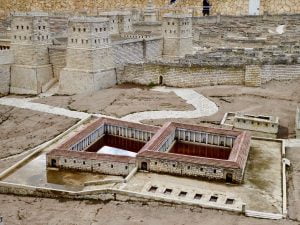 Although there is much symbolism in John's gospel, nosotros are increasingly realising that there is as well much history. Why does John annotation (in John 5.2) that the Pool of Bethesda has 5stoa (colonnades or porticos)? Until the 19th century, there was no evidence outside of John'southward Gospel for the existence of this pool; therefore, scholars argued that the gospel was written subsequently, probably by someone without first-hand knowledge of the city of Jerusalem, and that the 'pool' had only a metaphorical, rather than historical, significance. Just when the site was excavated, information technology was discovered that it did indeed have 5 colonnades—not in a pentagon, but every bit a rectangle with one colonnade crossing the middle. (See to the right my photo of the scale model in Jerusalem taken last year, with the Antonia Fortress behind the Pool of Bethesda.) And why does John note (John 5.5) that the man had been in that location for 38 years? Probably simply considering he had.
When reading John, and the other gospels, we demand to be alert to their symbolism. But we also need to have them with their full historical seriousness too—as previous generations take ofttimes failed to do.
In that location are a number of other things to annotation about the passage.
Having introduced the episode by careful temporal and geographical markers, the writer introduces the characters in a manner which anticipates the following action. The mother of Jesus is mentioned starting time; there is no particular significance in the omission of her proper noun, and it would exist appropriate to refer to her in relation to Jesus, since he is the principle focus here. Information technology places her in a role of importance, only non key to either the narrative or the gospel; she makes a significant contribution, but there are limits to her agreement of the situation.
Jesus is introduced next, and it is he who has been invited to the wedding every bit a guest (the verb is atypical) whilst the disciples equally tagged on, well-nigh equally an afterthought. As often happens in this gospel, the disciples are largely by-standers rather than major actors; their part here is to witness what has happened, and 'believe'. As in the episodes in chapter one, we find here a close juxtaposition between the 'mundane' reality of kinship obligation (as Jesus attends the wedding, most probable of a relative) and the cosmic significance of the action that manifests his 'glory', that which he has shared with his Father in John one.14 and which will be made fully manifest (paradoxically) when Jesus is lifted upwards on the cross (John 17.5).
The wine fails; the term hither,hustereo, can accept a sense of lack of quantity or lack of quality. Mary's argument to Jesus suggests the former, whilst the final response of the steward suggests the latter. Inside the first-century laurels/shame culture, it would non exist appropriate for a female parent to make a demand of her adult son, so Mary's comment is a statement, though clearly with the expectation of some response.
Typical of the Fourth Gospel's realistic speech, Jesus' respond is expressed in a semitic metaphor: 'What to me and to you?', an expression we find in exactly the same class in Hebrew in Judges xi.12, 1 Kings 17.18 and 2 Kings 3.13, all with the sense of 'What is at that place betwixt united states of america?' Given the context of these examples, we would exist correct to interpret Jesus' address to her equally 'woman' in a negative way; he is resisting her proffer, since she does non fully understand what the coming of 'his hour' volition involve. Withal she clearly expects him to practice something dramatic, hence her education to the servants.
Although in that location are no particular linguistic connections, the volume of the jars and the action of the servants in filling them 'to the very top', beyond the point where you would usually fill up them, points to the later linguistic communication of 'life in affluence' (John ten.10).
One time again, the honor/shame dynamic plays its part. The steward does not know where this best wine has come from, and credits its supply to the bridegroom, whose honour is thereby left intact since the humiliating failure is non made public. And at that place is an inversion of revelation, in that information technology is the servants who actually know the truth. But Jesus himself does not accrue honor in the social sense. Instead, he reveals his 'celebrity' to the disciples (who presumably have too observed the action). This get-go sign points forrard to the time when Jesus will be shamed rather than honoured in human terms, but the celebrity of God's grace in the life and forgiveness that menses from Jesus' crucified body—some other juxtaposition of 'claret and h2o'—volition exist fully revealed.
In a previous posting of this piece, Colin Hamer (who has published a fascinating study of marital imagery in the Bible ) offered this further observation about symbolism in the episode:
When asked to make up the shortfall of wine Jesus is said to declare that 'My 60 minutes is not yet come—Jesus is nonetheless recorded as performing the phenomenon and when the wine is produced the master of the feast comments on its quality and assumes information technology is the bridegroom who has made the provision (vv. 9–ten). Brant Pitre (Jesus the Bridegroom, 35–39; also: McWhirter, The Benedict Messiah and the People of God, 57) suggests that this was in accord with the Jewish hymeneals tradition where it was the benedict'south responsibleness to provide the wine (every bit inferred in v. 9). It follows that Mary had been, in effect, request Jesus to human activity as if he was on that twenty-four hours the bridegroom—such an analysis would explain his enigmatic reply to her. Pitre farther suggests Mary's reference to the lack of wine is an echo of Isaiah 24:7, nine, xi—Isaiah subsequently describing a hereafter restoration of Israel when Yahweh will ensure wine will exist in affluence (Isa 25:6–8). Thus Pitre sees that the writer of the fourth Gospel, in recounting such an extravagant supply of vino, is employing contemporary Jewish spousal relationship traditions to portray Jesus equally the divine bridegroom self-consciously taking the office occupied by Yahweh in the One-time Testament imagery.
I call up that that is a plausible observation, but with one qualification: why should nosotros come across this symbolism merely as the creation of the gospel writer, rather than as something in the mind of Jesus to which the gospel writer is alarm? I always find it odd when we ascribe theological sophistication to later characters rather than to Jesus himself! (See likewise Colin'due south own bookThe Benedict Messiah which offers his PhD enquiry in a popular format.)
How exercise we make sense of 'end times' linguistic communication in the New Testament? Should nosotros exist looking for 'signs' or predicting dates—or is at that place a better way to recollect nearly these things?
Bring together me for a Zoom pedagogy afternoon on Thursday February third, or come for a relaxing break and think about these issues at Lee Abbey in Devon on May 2nd to 6th.
If you enjoyed this, do share it on social media (Facebook or Twitter) using the buttons on the left. Follow me on Twitter @psephizo. Like my page on Facebook.
Much of my work is done on a freelance basis. If you have valued this post, you can make a single or echo donation through PayPal:
Comments policy: Practiced comments that appoint with the content of the mail, and share in respectful debate, can add real value. Seek first to understand, then to be understood. Make the nigh charitable construal of the views of others and seek to acquire from their perspectives. Don't view contend as a disharmonize to win; address the statement rather than tackling the person.
Source: https://www.psephizo.com/biblical-studies/how-should-interpret-the-six-stone-water-jars-at-cana-in-john2/
Belum ada Komentar untuk "How should interpret the six stone water jars at Cana in John2?"
Posting Komentar